As the Arctic Ocean faces ongoing warming and the breakup of the far north’s ice cap, access to the region, and to its resources, have become a greater concern for Arctic and non-Arctic governments. Ice erosion in the Arctic is shaping up to a halting process at best, as underscored by a study published this month about conditions in Canada’s Northwest Passage which suggested that local ice breakup would make the waterway less, not more, navigable in the near future as older sea ice drifts southwards, strengthening maritime chokepoints in the region and hampering shipping. Russia meanwhile has continued to promote its Northern Sea Route as an alternative maritime trade conduit between Asia and Europe, but progress has been slow due to post-2022 political roadblocks and questions over the predictability of ice conditions there.
Icebreaking vessels capable of operating in far northern waters have therefore continued to be subjects of political debate, as climate change continues to affect the Arctic and tensions between the West and Russia have the potential to spill over into the region. At the recently-concluded NATO summit in Washington, three Arctic governments, Canada, Finland and the United States, announced an ‘Icebreaker Collaboration Effort’. Also known as the ICE Pact, the three allies agreed to share relevant information and expertise with an eye to jointly developing new icebreaking ships, including for purchase by allies, which could operate effectively in the Arctic and Antarctica. A detailed blueprint for this initiative is to be drawn up by the end of 2024.

The ICE Pact, if successful, would also address what the United States had long lamented was an ‘icebreaker gap’ between itself and other major Arctic and non-Arctic governments. Shipyards in all three NATO Arctic countries would have the opportunity to construct icebreaking vessels, and one US firm, Bollinger, swiftly pledged its support for the initiative.
Canada has also been seeking to upgrade its icebreaker fleet at a time when the Justin Trudeau government announced last month that it was preparing a revised government Arctic policy in response to changed environmental and political conditions in the region. Arctic defence was also a strong theme in Ottawa’s latest defence policy [pdf] released in April this year.
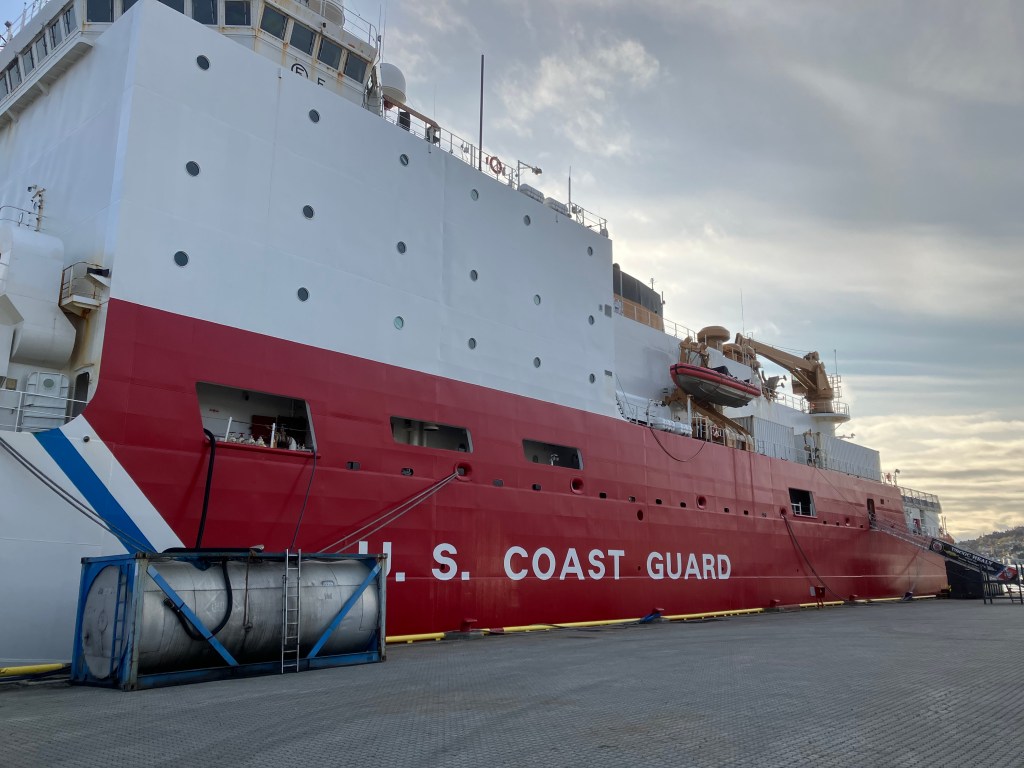
Icebreakers had also played a part in the Donald Trump government’s erratic and often mercurial approach to US Arctic policy. In June 2020, a memorandum was published by the White House which called for the acquisition of a ‘fleet’ of icebreakers, including polar-class security cutters (PSCs), to be in place by 2029. These ships would have eventually replaced the two icebreakers currently operating under the US Coast Guard, the Healy (launched in 1997) and the Polar Star (launched in 1973). As a potential stopgap measure, the Trump government also mooted the idea of leasing icebreakers until the American vessels could be deployed. Since that announcement was made, however, the initiative has been beset by repeated delays and ballooning costs, with estimates suggesting that the USCG would not have even a single new icebreaking vessel before 2029-30, despite initial plans for the first ship to be ready this year.
The primary anxiety for those arguing about an icebreaker gap in the Arctic has been the steady pace of Russian and Chinese shipbuilding efforts. Russia has over forty icebreakers of various types, including nuclear powered vessels with additional such craft being constructed under Moscow’s ‘Project 22220’ initiative. The latest of these is the Ural, launched in 2022. However, the next Russian nuclear icebreaker, the Yakutia, is reportedly now facing considerable budget strains as it prepares for a planned December 2024 launch. Last month, Russia began trials of its latest icebreaking patrol vessel, the Ivan Papanin, which is expected to be incorporated within the country’s Northern Fleet by the end of this year.
Since the successful launch of China’s Xuelong 2 / 雪龙2 (Snow Dragon 2) icebreaker in 2018, the country has sought to expand its own polar icebreaker capability as Beijing seeks to jump start its interests in the Polar Regions after a long pause during the global pandemic. Early last year, China’s third icebreaker, the Zhongshan Daxue Jidi / 中山大学极地 (Sun Yatsen University Polar) successfully completed a round of sea trials.

Last month, China’s fourth icebreaker, the Jidi / 极地 (Polar) was delivered to the country’s Ministry of Natural Resources, while the research vessel Tansuo Sanhao / 探索三号 (Discovery Three) is under construction (in Chinese) with a planned 2025 completion date. The need for icebreakers to assist in the development of Beijing’s Arctic policies, including expanded scientific research, was detailed in the Chinese government’s landmark 2018 White Paper on the Arctic. Reports had appeared in 2018 that China was also seeking to build an icebreaker with a nuclear engine, (thus far, only Russia has nuclear powered icebreaking ships). However, since the initial announcement, few details regarding logistics or timelines have been made available.
Both Canada and the United States are facing potentially difficult elections in the near future, and so the specifics and scheduling for the ICE Pact are not set. There are also questions about what the eventual demand for such ships will be in the coming years. However, this announcement has underscored the interest of NATO members in ensuring a stronger presence in the Arctic for strategic as well as scientific reasons.

 Over the Circle