
Initial assessments of US foreign policy as the first year of the second Donald Trump administration drew to a close have included growing concerns about the mercurial and transactional nature of American power abroad, as well as emerging signs of a sort-of isolationism, mixed with dashes of nineteenth century-style neo-imperialism. These facets have once again presented themselves in light of renewed US interests this month in ‘acquiring’ Greenland.
Greenland appears to be at the centre of emerging US Arctic policy While there has yet to be a revised Arctic strategy paper published since Mr Trump returned to office, US relations with several Arctic states have taken a turn for the worse since the start of the year, and there are already numerous signals appearing regarding the shape of American Arctic policy in the new year. These include a rejection of climate change, painting it as fictional and an ‘ideology’, and a shift back towards exclusive hard power development, including a renewal of calls for icebreaker construction and purchases, including via the ICE Pact with Canada and Finland.
The recently published US National Security Strategy reflected Washington’s populist turn, and although it did not mention the Arctic directly, many of the paper’s elements are relevant to American thinking in the far north. Russia’s invasion of Ukraine was only lightly addressed, with Europe largely blamed for its deteriorated relationship with Moscow, while the policy promised an emphasis on American ‘strategic stability’ with Russia. The Russian government even later praised the NSS paper as ‘largely consistent with our vision’.
Europe, by contrast, was extensively denigrated in the strategy, portrayed as facing ‘civilisational erasure’ due to immigration, and dealing with a supposedly undemocratic European Union. Finally, there was a greater emphasis on the US being the dominant actor in the Western Hemisphere, outlining an ‘enlist and expand’ approach to the region, echoing the historical US Monroe Doctrine and even suggesting a ‘Trump Corollary’ to the concept.
It remains to be seen, however, where the North American Arctic would fit into this thinking, especially since both Canada and Greenland have been repeatedly cited by the Trump White House as potential new additions to American territory. The latter, however re-entered the new this month with the sudden announcement that he was appointing a special envoy to Greenland, Louisiana Governor Jeff Landry, in order to facilitate the acquisition of Greenland, to ‘strongly advance our Country’s Interests for the Safety, Security, and Survival of our Allies, and indeed, the World.’
Governor Landry responded on social media by saying ‘It’s an honour to serve you in this volunteer position to make Greenland a part of the US,’ and ‘there is no better flag for freedom and opportunity than the flag of the United States. I look forward to sharing that message with the people of Greenland.’ He later softened those statements with assurances that the US doesn’t want ‘to conquer anybody’. Nonetheless, the announcement prompted a rebuke from the Danish government, with the US Ambassador to Denmark being summoned for explanations.
Greenlandic Premier Jens-Frederik Nielsen issued a statement saying that Landry’s appointment did not change the situation, and reiterated that ‘Our future is decided by us. Greenland is our country. We have our own democracy, our own decisions, and a strong community that stands firm.’ Greenland’s Foreign Minister, Vivian Motzfeldt, also confirmed that Landry’s appointment was made without any consultation with Nuuk. Opposition leader Pele Broberg, however, viewed the matter as an opportunity to better engage the United States as Greenland moves towards eventual independence. Several European governments, as well as Ottawa, reaffirmed their support for the sovereignty of the Danish Kingdom.
The exact rationale for the current US administration’s interest in Greenland has never been fully explained, but reasons have tended to fall under three categories. First, there are the rich resources found in Greenland, including base and precious metals, gemstones, uranium and rare earths. The latter has become a flashpoint in Sino-American relations as a result of Beijing placing controls on rare earths in response to waves of expanded US tariffs on Chinese goods. Despite these restrictions being loosened as a result of an agreement in October, obstacles to these exports remain.
Greenland has long been seen as an alternative source of strategic materials for both the United States and Europe, but mining in Greenland remains an expensive and time-consuming prospect. Although there have been some tentative discussions about expanded American investment in Greenlandic mining projects, there has been little in the way of concrete timetables. Chinese companies had been linked to four potential mining initiatives in Greenland, but all of these have either been delayed or abandoned due to financial or political reasons.
The second justification involves American concerns that Greenland represented a weak point in regional security. Greenland does lie near strategic waterways which can be used by the Russian navy to challenge European security. The US president sought to underscore this point with the assertion that ‘We need Greenland for national security, not for minerals… If you take a look at Greenland, you look up and down the coast, you have Russian and Chinese ships all over the place. We need it for national security. We have to have it.’
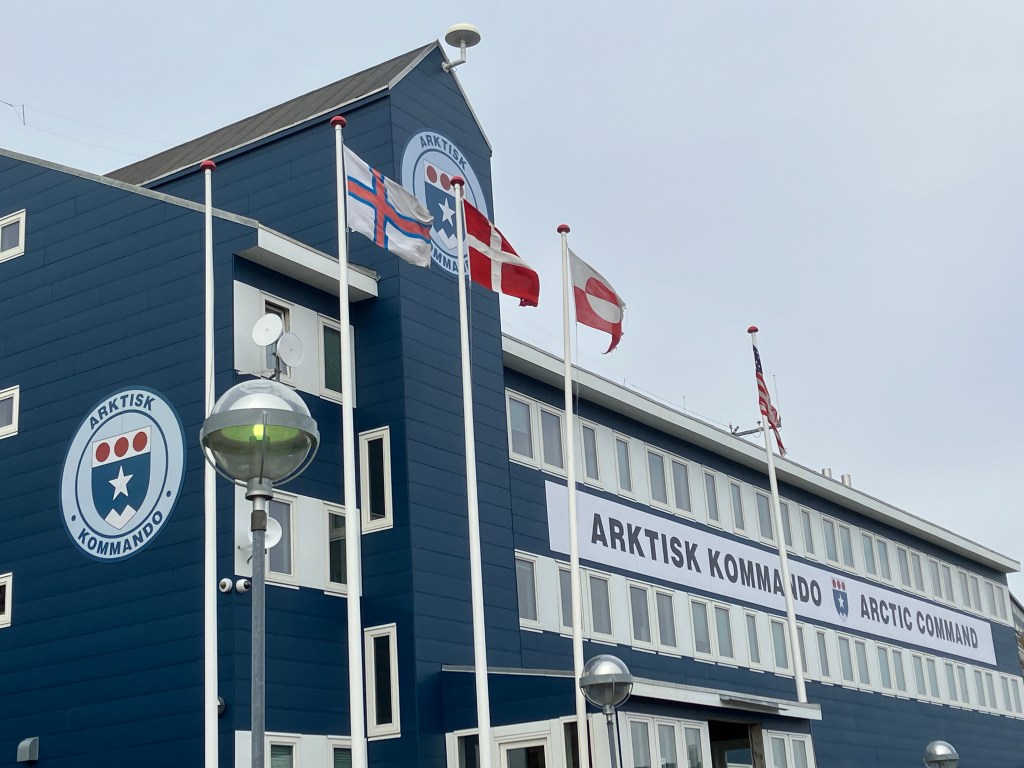
This stance, however ignores the already substantial military presence in Greenland, including the American military base at Pittufik, as well as plans unveiled by Copenhagen this past October to invest 27.4 billion DKK (US$4.26 billion) in Arctic military spending, including purchases of American F-35 jetfighters. The United States and Denmark are both members of NATO, which has upgraded its regional strategies over the past few years to better address threats in the far north. How American security interests would be further enhanced by annexing Greenland is thus unclear at best.
Third, and relating to the new NSS document, US interests in Greenland appear to reflect an archaic view of spheres of influence, which may also explain the American president’s views on Canada and the Panama Canal, as well as the ongoing attempts to Washington to provoke regime change in Venezuela. The classical view in international security that ‘more land = more power’ was largely considered obsolete by the end of the cold war and the rise of economic and technological globalisation.
As one 1996 comment in the journal Foreign Affairs suggested, the ‘obsession’ with land by governments faded during the twentieth century as trade intensified, the tertiary sector matured, and comparative advantage thinking prevailed. However, Russian attempts to illegally seize Ukraine put paid to the assumption that land expansion in the name of hard power was an extinct concept, and American policy towards Greenland may reflect similar regressive, zero-sum ideas of the links between territory and power.
More recent comments by the US President about the necessity of possessing Greenland reiterated a claim that it was needed for ‘national protection’ while adding that ‘They say that Denmark was there 300 years ago or something with a boat… Well, we were there with boats too, I’m sure. So, we’ll have to work it all out.” This statement reflects the ongoing tendency towards historical revisionism, often involving cherry-picking, by this administration.
Norse settlements of Greenland began in the tenth century CE, while the Lutheran missionary Hans Egede arrived in Greenland in 1721, marking the formal beginning of Danish oversight of Greenland. The US Declaration of Independence was signed in 1776, and the United States was formally recognised as an sovereign state in 1783. As well, such comments demonstrated an omnipresent willingness by Washington to ignore the population of Greenland as it pursues its strategies in the region.

Earlier this month, the Danish Defence Intelligence Service (DDIS, Forsvarets Efterretningstjeneste) published its annual Intelligence Outlook, and this year’s document was striking in many ways. In addition to addressing the challenge of adversarial great powers (Russia and China) and smaller states such as Iran, as well as the threats of terrorism and hybrid strategies. The Arctic also factored extensively into the document, but the region’s framing was considerably different from previous years. This reflected the return, at the beginning of this year, of Trump’s diatribes about annexing Greenland into US territory.
The report cited the ‘increased US focus on Greenland’, while also describing China as having had limited success with its earlier plans to invest in Greenlandic resources and infrastructure, and Russia as seeing Greenland primarily as part of the North American security milieu. This ran counter to repeated, unsubstantiated statements by the US president that ‘China boats and Russia boats’ were a direct threat to Greenland.
Concerns were also raised about the longer-term commitment of the United States to European security, as well as negative diplomatic impact of the Trump tariffs, and ‘the United States is leveraging economic power, including threats of high tariffs, to assert its will, and the possibility of employing military force- even against allies- is no longer ruled out.’ In the short term, this renewed American policy towards Greenland further threatens further spillover into US-Europe diplomacy as well as overall Arctic security.

 Over the Circle