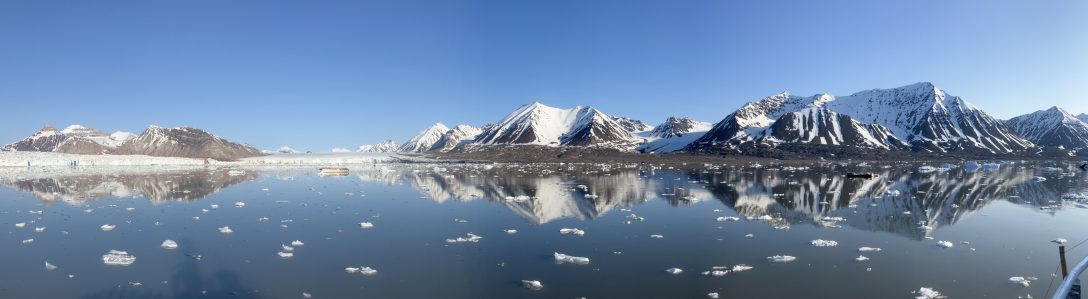
With record-setting high temperatures being experienced in much of Europe since the month began, the word ‘coolcation’ is making a comeback as more tourists, and cruise liners, seek to take advantage of the temperate conditions of Nordic summers. This effect is being seen throughout northern Norway, including Svalbard, which is becoming a more popular off-the-beaten-path destination. The tourist season on the islands is taking place however at a time when Svalbard remains caught between several developing geopolitical forces, including ongoing attempts by Norway to clarify its sovereignty there in the face of outside pushback, especially from Russia.
Moscow has had a long history of presenting various challenges to the legal structure on Svalbard, starting with the Spitsbergen / Svalbard Treaty of 1920, which came into force five years later. The document stated that Norway would enjoy ‘full and absolute sovereignty’ over the archipelago, while other signatories would have the right to engage is scientific and economic activities ‘on a footing of absolute equality’, and that the islands would not be used for ‘warlike purposes’.
However, since that time, Svalbard’s geography within the Atlantic-Arctic region, which is now becoming more open to maritime navigation due to climate change, as well as the worsening relationship between Russia and what is now commonly called the ‘seven like-minded Arctic states’, all of which are now NATO members, has resulted in different varieties of tacit challenges to the Treaty, and Norway’s position within it.

As a recent comment in the Barents Observer explained, both Russia and the previous regimes of the Soviet Union sought to increase their influence on Svalbard, often through policies consistent with ‘bilateralisation’. This means that that Moscow has sought to engage Norway for one-to-one dialogues on Svalbard’s governance, with the longstanding argument that Russia has special historical rights in the archipelago which Oslo should acknowledge. In other words, Moscow does not see itself as on the same level as the Treaty’s other non-Norway signatories but rather being or close to being equal with Oslo. Yet, with the Arctic now being more widely seen as a place of strategic competition, these pressures have begun to be more visible in nature. The Norwegian government continues to rebuff any Russian calls for direct bilateral talks on Svalbard.
This past March, the Russian government again made an accusation that Norway was tacitly seeking to militarize the islands in contravention of the Treaty. Moscow had previously accused Oslo of attempting to skirt the Treaty by allowing both patrols by the Norwegian Coast Guard, as well as periodic visits by naval vessels.
The Norwegian government has argued that it is within its rights under international law to monitor the islands, including using civilian and military vessels, and in January this year Norway’s Prime Minister Jonas Gahr Støre took the unusual step of reiterating Svalbard’s status as Norwegian, on the heels of a renewed, and still ill-conceived, campaign by the incoming Trump administration in the United States to annex Greenland for reasons never articulated.

Another sign of Norway seeking to clarify its authority on Svalbard took place in April this year when it was announced that all edifices in Ny-Ålesund needed to comply with a standardisation protocol which would include the removal of outside decoration, including the famous male and female lions standing guard in front of China’s Yellow River facility.
This decision followed an incident at Yellow River last July when tourists were photographed waving Chinese flags in front of the building, with one person being photographed in full Chinese military uniform. The event, to mark the twentieth anniversary of the opening of the building, was seen by Norwegian authorities as in breach of norms which discouraged both overt nationalism and military symbols on the site.
Since the full invasion of Ukraine by Russia in 2022, displays of Russian patriotism have also been seen at both of the country’s settlements in Svalbard, including the erecting of an Orthodox Cross near Pyramiden in May 2023, flying the flag of the separatist ‘Donetsk People’s Republic’ in a makeshift military parade in Barentsburg that month, and an ‘Immortal Regiment’ march also in Barentsburg in May this year. Last summer, Soviet-era flags and slogans could also be viewed at both settlements, but this summer all of that appeared to have been removed.

Also under the new regulations, in Ny-Ålesund all buildings there could no longer describe themselves as separate ‘stations’, with the argument that there was only one station present, namely the ‘Ny-Ålesund Station’.
In conversations with representatives from Kings Bay, the management body of the Ny-Ålesund site, when the author visited Ny-Ålesund last month, it was stated that the plans to standardize outside décor of the research facilities had been set in motion since 2019. As well, the incident at Yellow River last July did not affect these guidelines or the timeline in any way.
It was also stressed that none of the facilities management, had demonstrated any overt opposition to the new standards, although there had been incidents of previous criticism by Chinese officials about what was seen as Norwegian regulatory overreach. Moreover, the possibility of a Chinese firm possibly purchasing land in Svalbard last year also touched off debate, and ultimately resulted in Oslo’s decision to block any sale.
During the visit, the lions at Yellow River were still very much sitting in place, (along with the sign to the left of the front door identifying the two-floor building as ‘Yellow River Station – China / 中国北极黄河站’). There had been no noticeable changes to the other buildings, including those housing Indian and South Korean polar researchers. One change which was visible on site was that what had previously been ‘Sverdrup Station’, used by the Norwegian Polar Institute, at Ny-Ålesund was being referred to as a ‘unit’.

Moscow has since continued to press the issue of Norwegian Svalbard sovereignty, including by recently seeking to expand educational and research projects in Barentsburg and Pyramiden, including possibly in cooperation with the BRICS+ group and countries which Russia considers ‘friendly’ partners. As well, cruise ship arrived in Barentsburg last month from Murmansk, the first in over a decade, in another show of Russian symbolism.
This trip coincided with a visit to Svalbard by Norway’s King Harald V, who also visited another part of the Svalbard archipelago, Bear Island (Bjørnøya), located between Svalbard’s main islands and the northern Norwegian coast,* for the first time. For now, the ‘clash of symbols’ in Svalbard shows little sign of abatment as the summer tourist season continues.
* Corrected on 5 July to be more specific about Bear Island’s status.


