One of the many talking points which could be heard in the halls of Harpa in Reykjavík during this year’s Arctic Circle Assembly was about the soon-to-be-published revised Arctic strategy of the European Union, the first such document since 2021. Much in the far north has changed since then. The policy paper of five years ago stressed the EU’s commitment to a ‘Northern Dimension’ which included participation by the Union with Iceland, Norway and Russia, in various areas of Arctic cooperation, and placed a strong focus on combatting regional climate change and promoting far northern development. Given the current European security milieu, it was widely expected that this year’s iteration would reflect the eroding geopolitical situation in the Arctic, and the swift return of great power competition.
The 2026 EU Arctic policy strategy, entitled ‘Europe’s Northern Neighbourhood: A New Strategy for the Arctic,’ was released earlier this month, and the paper’s introduction wasted little ink on clarifying the drastically altered geopolitical circumstances in the far north. The region was no longer a zone of ‘predictability and restraint’, as due to both climate change and the ongoing effects of Russia’s post-2022 full invasion of Ukraine, EU policy needed to underscore the fact that ‘the Arctic is close, connected and critical to our future’.
Many previous European Union statements had explained the closeness of the EU to the Arctic, especially given that three of its members (the Kingdom of Denmark, Finland and Sweden) are Arctic states, with several other EU members either observers in the Arctic Council or also developing distinct Arctic policies. However, this new policy went deeper, stressing that ‘Europe’s strategic autonomy is inseparable from the Arctic,’ and that the EU was now seeking several different ways to either develop or improve its northern engagement endeavours.
Although downgraded in importance somewhat from the 2021 policy, climate change still took up a considerable amount of space in the revised version. Ice erosion, loss of permafrost, and the potential slowing down of the AMOC sea current were all designated as threats to European and Arctic peoples. The new policy statement recommended a two-pronged approach to addressing these challenges, namely taking steps to reduce pollution, including black carbon emissions, while supporting local sustainable practices, and improved monitoring through initiatives such as the EU’s OceanEye, which concentrates on developing more comprehensive maritime observation and data gathering.
These various threads were brought together under the rubric of the ‘Northern Neighbourhood’, which included many Arctic and Arctic-adjacent actors. Non-EU regional countries Britain, Iceland, the Faroe Islands, and Norway were cited as making significant contributions to the Union’s regional interests, including via bilateral trade, resource and security policies.
The role of the United States in the Arctic was also detailed, albeit with the caveat that ‘predictable partnership is central to European and transatlantic security, and key to preserve peace and stability and cooperation on joint challenges and opportunities.’ This as many European capitals were still facing the aftereffects of a botched American policy to annex Kalaallit Nunaat – Greenland, an attempt which ended last month with a trilateral deal that clarified the US security presence in Greenland but offered few additions beyond previous agreements, while costing Washington a great deal of political capital in the EU.
In the wake of the September 2026 agreement between the European Union and Greenland, which included a pledge to develop partnership packages totalling €200 million over the next two years and including joint development in communication, education, resources, energy and housing, the 2026 EU Arctic policy framed Greenland as an indispensable partner. Promises were made to further deepen economic cooperation with Nuuk, as well as include Greenland in EU data sharing endeavours and assisting in an energy reform process which would allow Greenland to transition away from a dependency on diesel fuel to wider use of renewables. Responding to interests in Nuuk for closer education and training links, the paper also called for the opening of a ‘youth sounding board’ as part of the EU’s consulate in Nuuk, opened in 2024.
Canada was also given much space in the policy document, reflecting warmer relations between Brussels and Ottawa as well as the ongoing poor relationship between Canada and the United States since the start of the current administration in Washington. Canadian businesses were hard hit by the post-2025 US-instigated trade war, and so the government Prime Minister Mark Carney has been seeking to diversify trade partnerships with Europe high on the wish list.
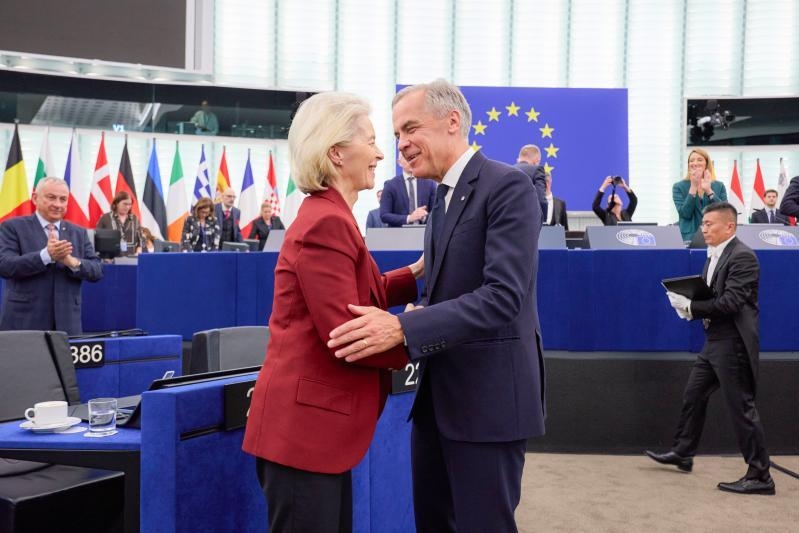
Canadian diplomatic efforts in European capitals have more than borne fruit, (there was even recent talk about granting Canada the novel status of ‘associate member’ of the European Union). It was speculated that one cornerstone of a deepened Canada-EU relationship would be mutual Arctic interests. During a meeting in Strasbourg between Prime Minister Carney and European Commission President Ursula von der Leyen, the latter confirmed that the far north would be a ‘flagship joint project’. At the end of this month, the twenty-first EU-Canada Summit was to take place in Montréal, with Arctic cooperation expected to play a major role.
Greenland was also cited as partners in various connectivity projects, including the planned IRIS2 satellite network which promises secure data transmission for governments, (Iceland and Norway are also non-EU participants in this project). Canada and Greenland were also cited as partners for one of the central infrastructure projects named in the EU report, namely the ‘Pan-Arctic Cable’, a data submarine cable which would extend from the European mainland, through Greenland and northern Canada and then on to Northeast Asia, reflecting closer diplomatic ties between the EU and Japan and South Korea.
This cable project illustrated the need for new reliable methods of data transmission, as well as concerns about keeping such lines safe from sabotage. Over the past four years, a series of cable cut incidents plagued northern Europe, including an incident in 2022 when a data cable connecting Svalbard with the northern Norwegian town of Harstad was severed under mysterious circumstances, as well as the severing of two data lines in the Baltic Sea during November 2024 which was linked to a Chinese cargo vessel, the Yi Peng 3.
The safety of the proposed Pan-Arctic Cable would be based partially on being kept away from Russian waters, given that Moscow has long been suspected of aiding and abetting numerous instances of underwater cable damage. The EU Arctic policy paper detailed the creation of a ‘Maritime Security Hub’, which would be responsible for developing regional information sharing and domain awareness for the EU, member countries and like-minded partners, (the EU paper called for freedom of navigation in the Arctic Ocean to be ‘preserved’). As well, a specific ‘Arctic Cable Hub’ with the mandate to monitor and protect cable systems in the Atlantic-Arctic would be created.
There have been other undersea cable projects proposed for the Arctic Ocean, such as the Far North Fibre project and Polar Connect, as well as the now defunct Arctic Connect project which was envisioned of making use of the Northern Sea Route with Finnish firm Cinia linking with Russia’s Megafon (МегаФон) cellular provider and potentially with China’s Huawei Marine, reflecting Beijing’s interest in developing a Digital Silk Road. However, this enterprise fell into abeyance in 2021 due to financial and security concerns.
Multilateralism was a common thread throughout the document, with the paper noting the importance of the Arctic Council as reconfirming its interest to become a formal observer in that group. At present, the EU is an ad hoc observer, with previous attempts at applying foe observer status first being opposed by Canada on economic grounds (regarding EU regulation of seal pelt bans, but the dispute was resolved more than a decade ago), and later blocked by Russia due to worsening political tensions after the 2014 Russian annexation of Crimea, with Moscow accusing Europe of trying to dilute Russian power in the Arctic.
The EU has also promised closer cooperation with NATO on military security through Structured Dialogue exchanges, as well as closer scrutiny of ‘grey zone’ threats in the form of what is now commonly called ‘FIMI’ (foreign information manipulation and interference). This would be countered by shared information exchanges and communications outlets, with steps to develop more robust community engagement and resilience. ‘Vigilance’ and ‘responsiveness’ were two keywords used in relation to the changed security situation in the far north.
As well, plans were floated in the paper for EU cooperation on the development of new polar capable icebreaker vessels. How this would fit within the existing post-2024 ‘ICE Pact’, an agreement between EU member Finland along with Canada and the United States, which is also based on joint icebreaker construction cooperation, was unclear.
The introduction to the revised EU Arctic strategy cited Moscow as having ‘reshaped the security of the Arctic and the EU as a whole,’ using both military buildups and various forms of hybrid tactics. China was cited once in the document, states as having ‘strategic ambitions in the European Arctic’ as well as ‘deepening’ cooperation with Russia. This one passage was enough to prompt a rebuke from Beijing, with the Chinese Foreign Ministry accusing the EU of ‘dividing countries into blocs out of the cold war mentality and inciting geopolitical confrontation’ while stressing that Chinese Arctic policy was based on ‘peace, stability and sustainable development’.
One Chinese news service added that the EU paper reflected a quixotic interest in driving a wedge between China and Russia in the Arctic, as well as representing ‘narrow-minded geopolitical thinking’ (xia’ai di diyuan zhengzhi siwei 狭隘的地缘政治思维), arguing that the Arctic should not be monopolised by any single power. China and the EU have been in delicate, ongoing talks this year to avoid a trade war between the two economies.
What the 2026 EU Arctic policy demonstrated was that the Union could no longer sideline hard security concerns in its engagement of the high north, and that the EU needed to better engage regional partners, especially in the Atlantic Arctic but also in the North Pacific, to better secure the region from both environmental and security threats. What will follow are questions how the EU will develop many of the initiatives drawn up in this document, and how the Arctic will feature Europe’s expanded foreign policy interests at a time when the far north can no longer be considered peripheral to the EU or to any other government.


